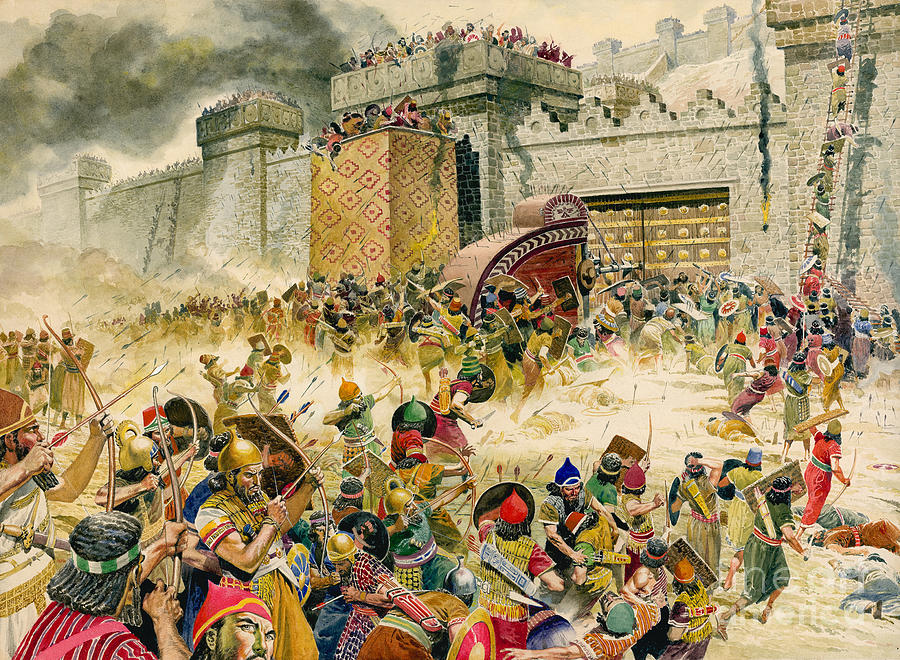
And the king of Assyria brought men from Babylon and from Cuthah and from Avva and from Hamath and Sepharvaim, and settled them in the cities of Samaria in place of the sons of Israel. So they possessed Samaria and lived in its cities.
—II Kings 17:24
When Satan wants to disrupt and eventually destroy a godly body, he introduces foreign DNA hostile to God’s creation and plans. This is true at the individual level (think disease from viruses and bacteria), in a family (the outsider in a marital affair), in an organization (the rebellious minority leading a coup), and even in a nation.
At a national level, the “Great Replacement Theory” is nothing new. Across time and place, an invading force seeks to undermine the culture and social fabric of the target nation, replacing its people with theirs, settling there, possessing the strategic heights (of political, economic, and social power) and conquering the cities (from which ideas and culture emanate). This was part of the Roman Empire’s playbook wherever they conquered. The strategy was known centuries before, as the conquest of Israel warns.
In Israel’s case, this replacement came after Assyria’s conquest of Samaria and its capital Damascus in 722BC. The Israelites were taken as captives and enslaved across the Assyrian empire, while foreigners—who did not know God—were imported from Babylon and elsewhere to replace them.
In other cases, including the times were in now, the invaders come not by military conquest, but by invitation and open borders. They first come quietly and unseen, and then in ever increasing numbers, subsidized by corrupt leaders and ensconced in homes and schools, yet remaining in segregated communities. They eventually demand more and more change to the native way of life, and a bigger piece of national wealth they did not labor to create. All the while the native population sleeps. Those who notice and question the logic of mass migration are told they are xenophobic.
Because the invading DNA is foreign, the host body initially rejects it. “At the beginning of their living there, they did not fear the Lord; therefore the Lord sent lions among them which killed some of them” (II Ki. 17:25). This put the fear of God in the imported foreigners, and they learned to appear upright according to the religion of the land. They gave lip service to the worship of the Lord, “but every nation still made gods of its own and put them in the houses of the high places which the people of Samaria had made, every nation in their cities in which they lived” (II Ki. 17:29). The mixture of unholy with what was once holy renders everything unclean. Opposing forces pull in contrary directions in a futile game of political and cultural tug-of-war, and progress is stymied.
With the passage of time, the wicked gain enough influence to impede the work of those who follow God and seek to fulfill His plans. When, generations later, the Israelites returned from captivity in Babylon with king Cyrus’ blessing to rebuild the temple, these malevolent transplants resisted the work of God. Despite the royal mandate, “the people of the land discouraged the people of Judah, and frightened them from building, and hired counselors against them to frustrate their counsel all the days of Cyrus king of Persia, even until the reign of Darius …” (Ezra 4:4-5).
It is for this reason Paul warns us, “Do not be bound together with unbelievers; for what partnership have righteousness and lawlessness, or what fellowship has light with darkness? Or what harmony has Christ with Belial, or what has a believer in common with an unbeliever? Or what agreement has the temple of God with idols? For we are the temple of the living God; just as God said, “I WILL DWELL IN THEM AND WALK AMONG THEM; AND I WILL BE THEIR GOD, AND THEY SHALL BE MY PEOPLE.” Therefore, “COME OUT FROM THEIR MIDST AND BE SEPARATE,” says the Lord. “AND DO NOT TOUCH WHAT IS UNCLEAN; and I will welcome you” (II Cor. 6:14-17).
Be careful whom you let into your heart, your family, your community, and indeed, your nation. Removing what has been allowed to infest the body is a difficult and often painful process. This does not preclude evangelism and lovingly welcoming the stranger who truly seeks to know the Lord. We must “extract the precious from the worthless.” “They for their part may turn to you, but as for you, you must not turn to them” (Jer. 15:19).