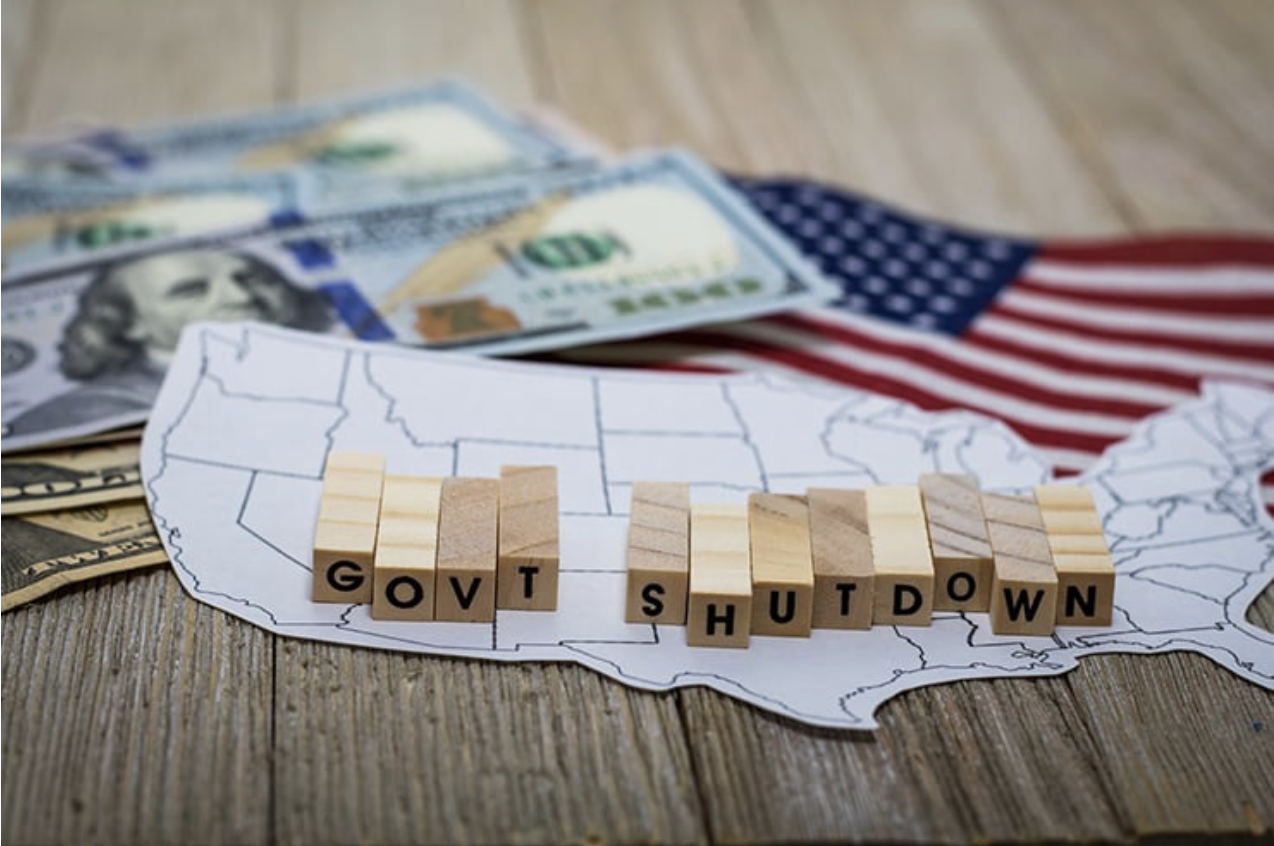
The United States government, unable to reach agreement on a budget for the new fiscal year, has been officially shuttered for well over a week. Since budgetary rows and the threat of government closure have become a more regular occurrence in recent years, we no longer flinch at what used to be a frightening prospect for Americans. Sure, budgetary crises happened in “banana republics,” but it used to be unthinkable in America. As the leader of the free world and the issuer of the global reserve currency, some greater degree of fiscal propriety and common sense was presumed.
Today, many Americans don’t seem to appreciate that this stalemate represents a profound crisis in our nation, both politically and financially, and presume that the issue will resolve itself. We are comforted by equity markets that have shrugged their metaphorical shoulders, and remain near all-time highs driven by what appears to be a bubble in Artificial Intelligence and related technology.
While much of the budgetary debate is shrouded in bureaucratic obscurity, the issues that divide the Republican and Democratic congress members are rooted in a philosophy of the role of government and the meaning of money.
The Democrats want to see entitlement benefits, especially around healthcare and Medicaid, renewed or extended to appeal to their voter base. Many of these perquisites were augmented by the Biden administration in the COVID-19 era, when handouts were considered necessarily to offset the effects of government-mandated lockdowns and closure of businesses. But once an entitlement is given, it is very difficult (and politically dangerous) to retract it. Republicans want to curtail these benefits, and rescind some funding already appropriated for foreign aid and public broadcasting, but are only trimming around the edges. Both parties continue to ignore the elephant in the room, which is the raging Federal deficit and the untenably high level of national debt, foreshadowing an inevitable monetary and financial crisis that may one day burst upon us all.
The antagonists are arguing over whether to spend somewhat more or a whole lot more, and on what. This is the wrong debate. It is like spouses bickering about how much and where to spend on home improvements, while neither of them seems to notice that their kitchen is on fire.
And indeed, in financial terms, the proverbial kitchen of the U.S. government is already on fire. Yet there has been no real attempt to address the fiscal crisis, to end deficits and runaway spending, and to get the national debt under control.
If equity markets don’t seem to care, the bond markets do. They notice that the U.S. now has nearly $38 trillion of national debt, equating to over $335,000 per taxpayer, and is running unsustainable deficits in the trillions of dollars each year. This has resulted in significantly higher borrowing costs for the U.S. government, which now pays well over a trillion dollars in debt service costs (i.e., interest) annually. Such astronomical amounts can only be funded by more debt, as Federal revenues are insufficient. As a result, the independent credit ratings agencies have one by one downgraded the sovereign debt rating of the U.S., in part because “Congress, characterized by political polarization, gridlock, and brinkmanship, is unable or at least unwilling to effectively govern or do anything to solve the problem.”
In the meantime, much of the government has continued to function, as a number of services and programs are exempted from shutdowns. This has permitted, at least for the time being, the brinkmanship to continue on both sides. With payrolls for military and federal employees coming up later this month, this perceived nonchalance may change. History reveals that when armies don’t get paid, politicians wake up quickly.
It is a bit embarrassing as an America to watch this play out. We are roundly mocked by our adversaries abroad over this issue, which would never occur in China, Russia, or elsewhere. And they are right in substance. We cannot borrow ourselves to prosperity while our national wealth dwindles.
Anticipating these events, I wrote at the start of the year to “expect gold to shine in 2025.” It certainly has, as reflected in prices. Gold has now topped $4000 per ounce, an all-time high, and an increase of 57 percent year-to-date. The rally in gold is not over. Analysts are expecting gold to go higher, with one investment bank raising their estimate by 15 percent and now projecting $4900 per ounce (22.5 percent higher) by year end 2026. The reasons I foresaw this included loss of faith in the financial stability of the U.S. government and thus the U.S. dollar, accumulation and hoarding by dollar-skeptic central banks around the world, and the fact that more and more investors, and Americans generally, are waking up to the severity of the underlying fiscal problem.
Similarly, bitcoin (BTC) prices reached a new all-time high earlier this week of over $125,000, more than doubling in value from one year ago. Both gold and BTC are seen as hedges against inflation and devaluation of the currency. Buying of both assets by exchange-traded funds (ETFs) and other institutional buyers is further driving prices upward.
The budget stalemate will resolve, both sides will declare victory, and life will go on. But we are only kicking the can down the street. At some point we will reach the end of the road. We will be confronted with a fiscal cliff, a moment when the U.S. government will have to choose whether to substantially raise taxes, cut expenses, and reduce the debt.
Alternatively, and this is the politically easier way out, the government will decide to devalue the currency, allow inflation to run rampant, and keep the monetary printing presses running, even if that means using the Federal Reserve to buy U.S. debt at subsidized rates of interest in the absence of market investors. In this context, gold, BTC, and other hard assets seem a reasonable option for individual Americans to preserve their wealth otherwise being eaten away by taxes, inflation, and increasing indebtedness.